
Celebrating 10 Years of a Modern Workhorse:
The Sequential Prophet-6
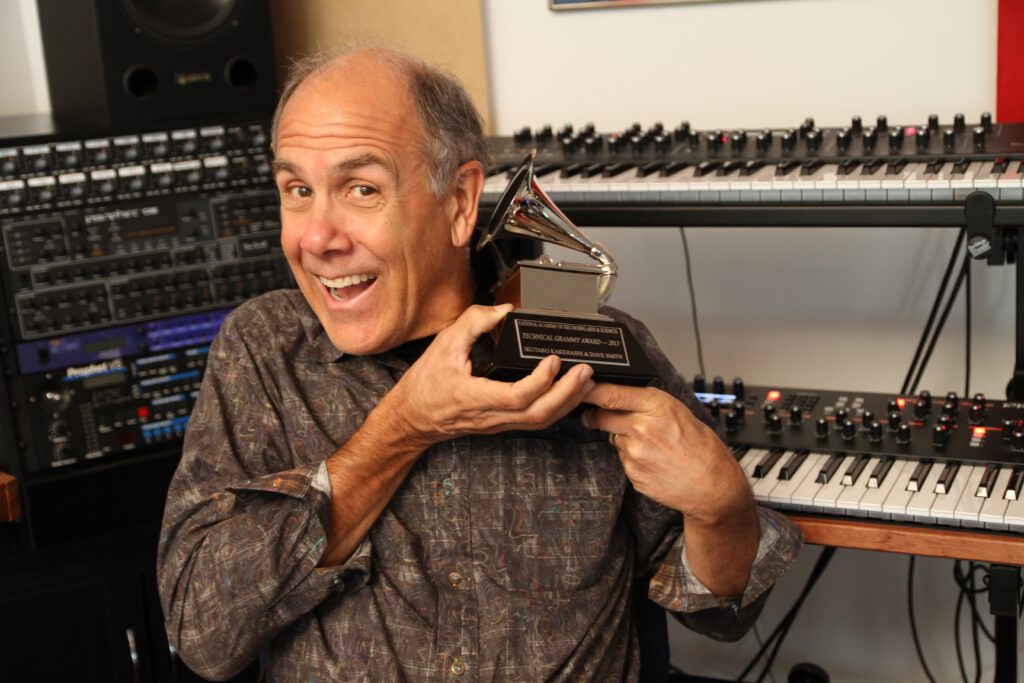
In 2013, Dave Smith and Roland founder Ikutaro Kakehashi were awarded a Technical GRAMMY for the development of MIDI. This set off a chain of events that neither Dave nor any of us working with him would have anticipated. Unbeknownst to Dave, Mr. Kakehashi contacted Yamaha Corporation President Takuya Nakata and asked if he would return the Sequential trademarks to Dave. The trademarks had transferred to Yamaha when they acquired the assets of Sequential Circuits in 1987, but they had never used them. Yamaha very generously agreed to the transfer, asking only that Dave pay the legal fees, which—as legal fees go—didn’t amount to much. For context, we subsequently paid about 5 times that amount for the sequential.com domain name, which I negotiated for and bought from a computer/software consultant who had used the name for his business. And that was considered a reasonable price for a single, dictionary-word domain name at the time.
We then had to decide how we were going to use the trademarks. I don’t think there was any immediate thought to change the company name, at least on my part. Initially, the idea was that maybe Dave Smith Instruments would continue to develop more “modern” instruments while there would be a separate line of more classically styled and inspired instruments sold under the Sequential name. In retrospect, not a great idea, but we had put a lot of time and effort into building the Dave Smith Instruments brand and it was finally starting to pay off. We were reluctant to change a brand name that was gaining momentum in the market. Add to that the fact that both Dave and I had experienced Sequential Circuits, and Dave Smith Instruments felt very, very different in so many ways.
Dave Smith is still not a household name—except in the households where one of the thousands of other Dave Smiths live—but when Dave started Dave Smith Instruments in 2002, even a lot of synth geeks weren’t aware of the connection between Dave and Sequential Circuits. Dave had always maintained a fairly low profile. There was a good chance a musician would know “MIDI,” might know “Prophet” and, fewer still, “Sequential Circuits,” but Dave generally flew under the radar. And he liked it that way. When Bob Moog and Tom Oberheim started new companies, they could no longer use their own names, but people knew their names. (In the late ’60s, “Moog” was literally synonymous with “synthesizer” for some people, even if the synth was not a Moog.) When Dave started a new company, he could no longer use his original brand name and people were mostly unfamiliar with him. That started to change gradually with the release of the Prophet ’08 in 2007 and the sharing of information via the Internet.
Dave and I started talking about what the return of the trademarks would mean to Dave Smith Instruments almost immediately after he learned of Mr. Kakehashi’s efforts. Two things seemed obvious: We needed to make a Sequential-branded instrument and that instrument should pay tribute to Sequential Circuits instruments of the past, the Prophet-5 being the obvious choice. Then our thoughts turned to, what would a 21st century Prophet-5 even be?
- If a Prophet-5 has a graphic display, is it still a Prophet-5? A big part of the experience of playing synths from that era is that you must depend much more heavily upon your ears. While it would certainly be useful to have program names displayed, it might be difficult to resist the temptation to use menus to solve whatever operational issues might crop up during development. If it had a graphical display, but only displayed program names and numbers and a global settings menu, would there be complaints that we underutilized the display? We opted for a third 7-segment display to accommodate more programs and more MIDI-friendly program numbering. (The Prophet-5 had two 7-segment displays and discontiguous program numbering.) That would necessitate coming up with a way to display and edit global settings using the 7-segment displays.
- No graphic display meant the synth would be knob-and-switch-per-function. Though there are obvious benefits to the player—like no menu diving, no modal operation (so knob and switch behavior never changes), and facilitating a preset-off or “live-panel” mode—we were a little concerned that some might find this too limiting. It was certainly a philosophical departure from the other DSI designs up to that point that had a lot of knobs and switches and shallow menus to access even more parameters.
- We made the very intentional decision to put a 4-octave keyboard on it, fully aware that it might be controversial for some. I may go into greater depth on this subject at some point, though I don’t know that it’s warranted all these years later, especially seeing as the instrument was very successful and has many more champions than detractors. Was there any discussion of making it 5 octaves? Of course, and there were proponents within the company, but Dave and I were in sync on this matter from the start.
- The instrument would be conceived with gigging musicians in mind, so it needed to be durable, (relatively) compact and light weight, and—though it was potentially controversial in an analog synth at the time—it should have onboard digital effects, potentially one less thing to carry.
- Finally, we decided that this would be the Prophet-6 because a) that’s what comes after Prophet-5 and b) Dave had always felt that 5-voice polyphony was a little too limiting. (When the original Prophet first shipped in 1978 it was available in 5- and 10-voice versions, but the 10-voice suffered from technical issues and was quickly discontinued. Had that not been the case, the Prophet-5 may have been the historical footnote.)