
It’s Alive!
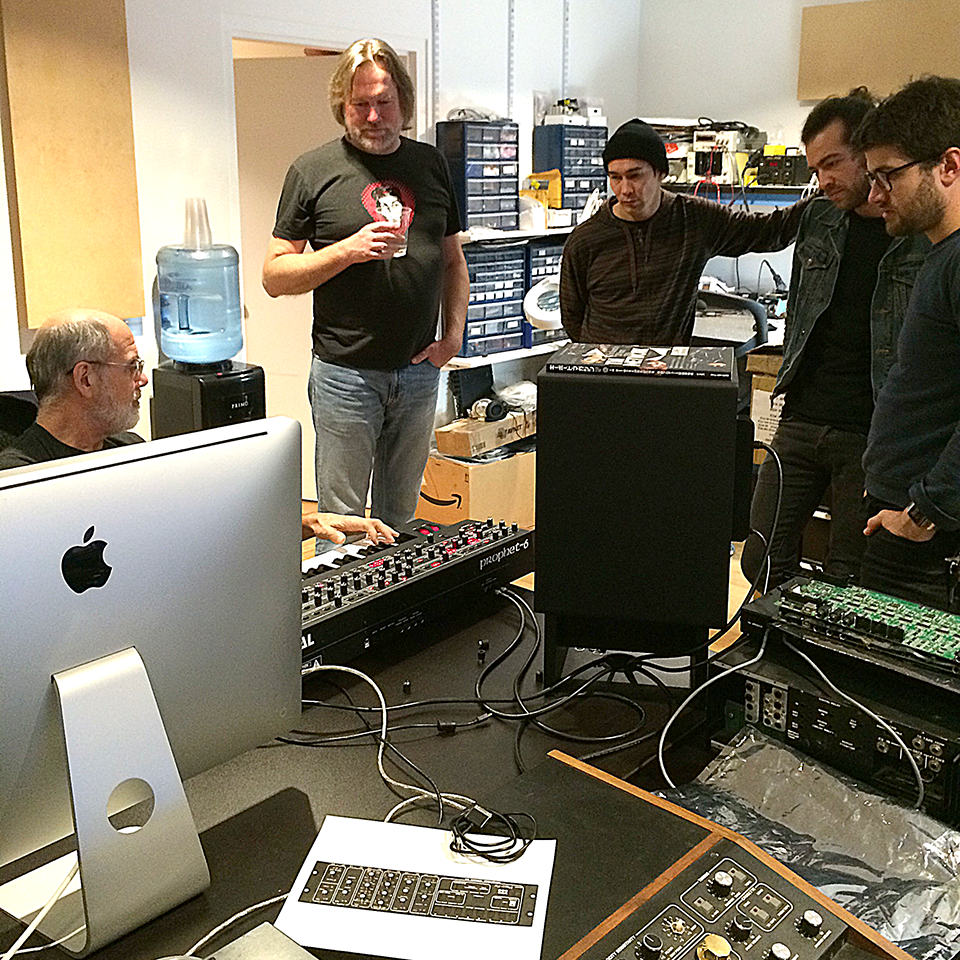
I didn’t document the development timeline for the Prophet-6 at the time, but some of the milestones can be determined from web searches and the few files that I still have.
- February 9, 2013—Dave and Kakehashi-san Awarded Technical Grammy for MIDI
- April 29, 2014—Preliminary list of front panel parameters
- June 24, 2014—Initial front panel layout drawing
- October 2014—Mechanical design and panel PCB layout begins?
- December 19, 2014—First of 5 alpha units assembled
- January 22, 2015—Re-acquisition of Sequential trademarks and Prophet-6 announced and alpha unit debuts at Winter NAMM.
- Early 2015—Fifteen beta units assembled
- May 2015—First production units ship
After the development really got under way in October of 2014, my memory of what happened and when is spotty. That’s not surprising, given that I was doing mechanical and graphic design while working with our vendors and contract manufacturer who would be handling the production of various parts, including metalwork, wood, nameplates, the Prophet-style switches, the 7-segment displays, display windows, and key bed. In retrospect, the fact that we went from a panel drawing to alpha units in roughly two months is mind boggling. During this time I was coordinating with Tony and Chris who were working just as hard cranking out hardware and software designs. Tony probably got a head start on the schematics before I could give him dimensions for the PC boards and Chris likely did some architectural software work, but a ridiculous amount of work was done during those two months. (I hope to talk to Tony and Chris about the Prophet-6 in the future.)
I do remember the first time I played a Prophet-6. It was on a table in Dave’s office at DSI in San Francisco. I walked up to it and played it and was immediately both relieved and excited. Relieved because it already sounded very good and excited because the potential was obvious.
That first instrument was one of five alpha units built. In researching this, I was surprised to see that the instrument that appears in Dave’s introductory video is an alpha. By extension, the instrument heard in Peter Dyer’s soundtrack to the video would also have to be an alpha, as were demo units at NAMM. Clearly, they were mechanically solid and sounding good even though they were not feature complete.
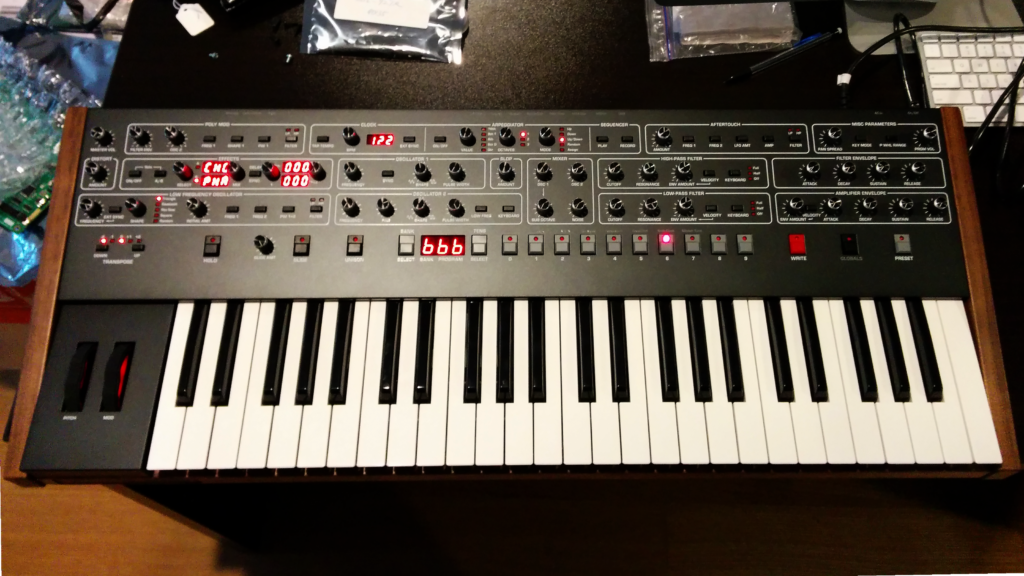
What changed between alpha and beta? There were likely lots of software changes and some hardware changes, but I’m only qualified to talk about the parts I was responsible for. As mentioned earlier, the original design only had 5 clock divide values. The beta version has twice as many. (The order of the clock divide values changed between beta and production, but that only necessitated minor changes to the OS and the panel’s screen-printing art.) The alpha version only had 1 bank of 10 global parameters. It quickly became apparent that was not enough, so the beta had 2 banks and the Globals switch went from having a single, red LED to two, red and yellow. As I also mentioned earlier, the Off LED was removed from the two filter keyboard tracking switches and the layout was tweaked to match the other small, 2-LED switches. I still have one of the beta units and it is as fully functional as, and compatible with, the production version. (I have a production unit, too.)
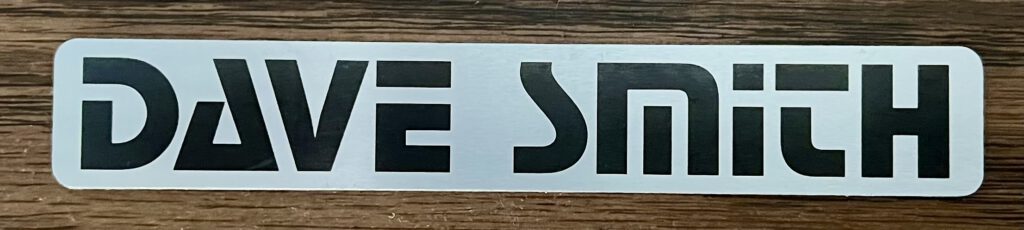
While on the subject of the name plate, here’s another bit of trivia. From its inception, the Prophet-6 was intended to be a Sequential product, but there was some reason—that I no longer remember—that we might not be able to use the name Sequential, so an alternate version of the name plate on the front of the synth was made that read “DAVE SMITH” in the same typeface as the Sequential logo. I am very happy that we were able to use Sequential.
Why is it “Sequential” and not “Sequential Circuits?” Though Dave’s original company was Sequential Circuits Inc, customers and industry folks tended to refer to the company as “Sequential” or “SCI” at the time. And who could blame them, really. Sequential Circuits Inc is too damn long, especially in an age of domain names and email addresses and hash tags. Too much typing. Thankfully, SCI had dropped “Circuits Inc” from the products by the mid-’80s, opting for just “Sequential,” so we went with that. (If you want to get really picky—and I know how some of you synth folks can be—the original name of the company as it appears on early products and the first t-shirt is Sequential Circuits Co, not Inc.)