
Details, Details…
Having established a rough concept, it was time to start filling in the details. Dave surprised me, saying, “You know what it should be. You do it.” It wasn’t that I didn’t feel up to the task. I just didn’t expect it. Honestly, I did feel like I knew what it should be. At that point I’d had 35 years to think about it. I don’t think it was until I left Sequential in 2024 that I really had a chance to consider the implications. The guy who designed one of the most significant synthesizers in history had given me the opportunity to design a follow-up. In 2014, I was excited by the prospect, but I had a lot to do, and my focus was on doing it well, just as it would be with any other instrument design.
The reasoning behind Dave’s decision was simple: He had no interest in making another Prophet-5 or even a Prophet-5-like synth, so it was easy for him to hand it off. Almost from the time the Prophet-5 ceased production, people had been asking him to make another one and he declined. He always wanted to do something new, not revisit the past and repeat himself.
(Obviously, Dave changed his mind at some point or there would be no Prophet-5 Rev 4. As to why, Dave had his public pat answers, as he did for many frequently asked questions. I don’t recall ever asking him directly why he had a change of heart, though I have some thoughts about it. Since the man is not here to confirm or deny, I will keep my thoughts to myself.)
Forward, Into the Past!
Having worked at Sequential Circuits from 1979 to when the company folded, there was—in my mind—only one synth that was a direct descendent of, and successor to, the Prophet-5: the Prophet T8. Honestly, I have mixed feelings about the T8. (It doesn’t help that, as a production technician, I calibrated many, many of the keyboards, which was a time-consuming and tedious job.) The biggest issue I had with it was that its raw sound did not, in my opinion, compare favorably with the Prophet-5. That said, the T8 had some evolutionary improvements that were among the first features I added to the Prophet-6.
Programmable LFO Amount
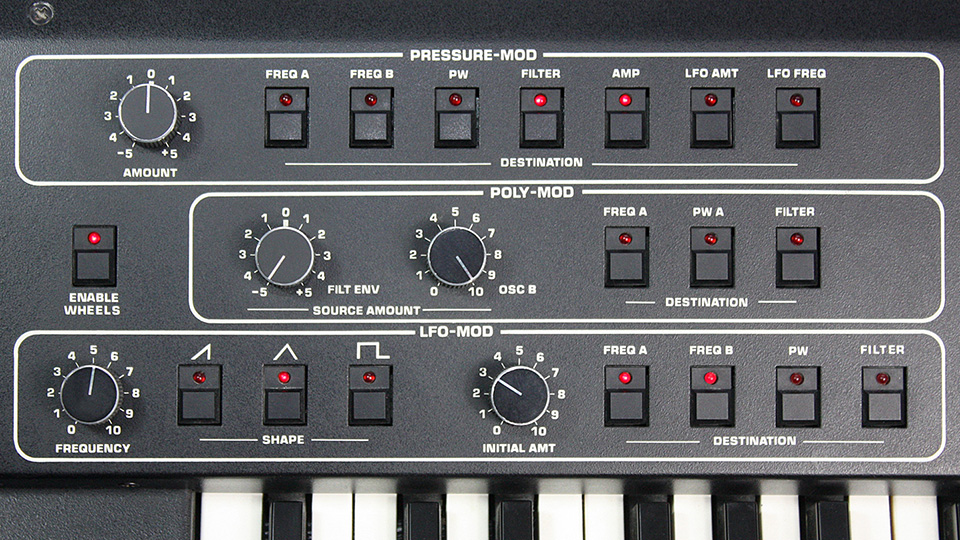
The Prophet-5 was the first fully programmable polyphonic synthesizer. Mostly. Let’s say you’re at a gig and there’s a patch used in a song’s verse that requires the LFO to be on continuously, so you push up the mod wheel and start playing. Then you change to the patch for the chorus, hit the first notes and…. Oops. You got lost in the moment and forgot to return the mod wheel to minimum, so the synth is playing with unwanted vibrato or whatever the LFO is routed to for that patch. The T8 addressed this by adding an Initial Amount parameter to the LFO section, making the LFO amount programmable and not dependent upon the wheel setting.
Bipolar Modulation
Another thing the T8 added was bipolar modulation amounts. That is, some of the mod amount knobs could be set to positive or negative values. This was one of my favorite T8 features and it expanded the synth’s sound design capabilities in a very simple and effective way without adding knobs or switches. And that was important, considering that real estate on the Prophet-6’s front panel would be somewhat limited by the 4-octave keyboard.
Program Volume
Program Volume also debuted on the T8, but that was already a standard feature on DSI synths.
Unison to Mono and All Points In-between
I have always felt that the Prophet-5 was somewhat lacking in its capabilities as a mono synth. Ten VCOs stacked in unison can be great if girth is your goal, but there are applications when just 1 or 2 oscillators is preferable and there is no easy way to achieve that in unison mode. The Prophet-6 would use any number of its 6 voices for unison patches, along with detuning for 2 or more voices. Chord Hold, which can be traced back to the T8 and Prophet-600, would be added as an alternate, programmable, Unison mode.
Hold On…
While on the subject of Hold, I don’t think the Hold button was on any SCI synths and first appeared on a DSI instrument with the Prophet 12. I was inspired by seeing Jason Lindner with the Proverb Trio. I noticed that he used the Envelope Gate switch on a Moog Voyager to gate the voice on and make it drone, making two-handed knob twiddling (and a whole lot of fun) possible. Prior to the Prophet 12, drones on DSI instruments could be achieved by turning up the VCA level, but on the polyphonic instruments, that meant all the voices would sound. Hold causes whatever voices are gated on manually to be held until Hold is turned off.
We’re Not in 1983 Anymore
MIDI may have had the most profound effect on the design. The Prophet-5 never really had fully integrated MIDI. Even the later Rev 3s that shipped with MIDI had the same MIDI kit installed as instruments retrofitted with MIDI. The only difference is that the holes for the DIN jacks came from the metal vendor pre-punched.
The Prophet-5’s MIDI implementation was rudimentary. It goes without saying that the Prophet-6 would have a 21st century MIDI implementation with full automation capabilities, but what about synchronization? Clock sync is vital for a lot of modern music production. What, exactly, is getting synchronized? We had an LFO and (presumably) time-based effects. We had already been considering an arpeggiator, but the ability to sync it to other onboard features made it seem like a necessity. (My memory is a bit foggy on the subject, but I don’t think the step sequencer came into play until I started drawing the front panel.)
Me, Me, Me
There were a few things that I really wanted in the Prophet-6 that were not Sequential Circuits-like. I’m a big fan of distortion as an effect and I lobbied hard for it to be included in Tempest, the first DSI synth to include it. Dave and Roger Linn had come up with a simple high-pass filter into asymmetrical diode clipper circuit that found its way into subsequent instruments, so I added it to the Prophet-6. As anyone who is familiar with an Evolver probably knows or, at least, suspects, Dave liked grungy sounds and didn’t need any convincing to add a distortion. (On the other hand, when I was designing the OB-6, Tom Oberheim’s only instructions to me were that he wanted the OB-Xa’s blue lines and no distortion. Of course, as soon as the sound designers got their preproduction OB-6s, one of the first questions was, “Where’s the distortion?” Since the Prophet-6 and OB-6 share a common main board and the distortion is on that board, the distortion could be added back in as a hidden feature, but I still regret that it doesn’t have a dedicated knob.)
Tempest was also the first of our instruments to have an analog high-pass filter per voice. For the Prophet 12, resonance was added to the high-pass and I felt like it opened up a lot of possibilities. One thing to consider when designing an analog poly synth is that any feature added to the voice architecture gets multiplied by the number of voices, adding to the cost. The resonant high-pass filter is relatively inexpensive, so I felt its inclusion was warranted given the added sonic flexibility.
I like suboscillators. One thing I don’t like about most suboscillators is that I feel the waveshape—typically a square wave an octave below the oscillator frequency—adds harmonics that I don’t necessarily want. I much prefer the suboscillator to reinforce the fundamental to add “beef” without affecting the overall timbre. Ideally, that requires a sine wave suboscillator. The issue is that a square wave an octave down is easy to generate and “parts light.” That is, inexpensive. That is not necessarily the case with a pure sine wave. So, I asked our hardware engineer, Tony Karavidas, if he thought he could come up with an inexpensive solution to generate a triangle-shaped suboscillator, and he said he thought he could. He may have regretted that later, as I think considerable tweaking was necessary to maintain the triangle symmetry. I think it sounds great, though, so thank you Tony. (The OB-6 has square wave suboscillators, but I think they sound good paired with the buzzier, more aggressive-sounding SEM filters.)
Another small thing that I wanted to add was the dotted 8th note value to clock divide, which had not been available in previous DSI products. Because I like David Gilmour. (If this doesn’t make any sense, listening to Pink Floyd’s “Run Like Hell” might shed some light?)
The Survey
Dave always liked to say that the instrument designs were entirely generated in house with no external input, though that was not entirely true. The initial idea for Tetra came from Morgan Page at a NAMM show. Morgan had a Prophet ’08 and a Mopho module. He was traveling a lot and said he liked the Mopho form factor—I think he said it fit in his shaving kit—but wished it was polyphonic. Dave and I looked at each other and literally said, “Hmmm.”
I also had a small circle of people I consulted with over the years, not necessarily well-known artists, but professionals who work with synths daily. I wouldn’t ask them vague questions like, What do you think we should make? More often than not, it was more along the lines of, I’m thinking of doing <insert feature/design idea here>. Is that dumb? Occasionally they would say, yes, that’s dumb. (Thank you, Peter Dyer.) And sometimes I wouldn’t listen to them even if they did, if I was convinced it was something worth pursuing.
For the Prophet-6, I did something I never did with any other instrument: I sent out a questionnaire asking a few people some specific questions about a hypothetical, Prophet-5-like synthesizer. I wish I still had the questions, as I don’t really remember what I asked. I know I asked about 4 octaves versus 5, even though that decision had already been made. And I wanted to get a sense of how people might feel about digital effects on an analog synth.
I also don’t remember exactly who I sent the questionnaire to. I know I asked Dave Stewart (Hatfield and the North, National Health, Bruford, Dave Stewart and Barbara Gaskin). Dave has long been one of my favorite Prophet-5 players. (If I recall correctly, Dave wanted 5 octaves and no digital effects. Sorry, Dave. I do have a vague recollection that he asked about a desktop module to replace his Creamware Pro 12 ASB? Maybe that was later, though, when we were working on the Prophet-5 Rev 4.) I believe I may have asked Mike Lindup (Level 42) who was the first artist I ever saw (Keystone Palo Alto, 1985?) who was not content just to push preset buttons and actually turned knobs and interacted with the Prophet-5 while performing. I would have asked Richard Barbieri (Japan, Rain Tree Crow, Porcupine Tree), but I don’t think I was in contact with him in 2014. Maybe Atticus Ross? Drew Neumann? John Bowen? Probably Jason Lindner. Almost certainly my old friend and former bandmate Robert Rich. Definitely Peter Dyer and Matia Simovich.
In any event, the questionnaire was not particularly helpful and I never used that blanket approach again. I would, however, continue to ask specific questions of specific people from time to time just as a reality check.