What if you made an instrument and nobody played it? Thankfully, I can’t answer that question, but it would surely suck. I am not much of a musician. I am definitely not a keyboard player. Nonetheless, I have dedicated a significant portion of my life and probably too much of my mind to helping create musical instruments and tools, and most of the satisfaction I’ve derived from that is a result of hearing and seeing what musicians do with them. That excites me more than any music I might create. Contributing to a team that created musical instruments was my creative outlet.
I’m not going to attempt a list of well-known Prophet-6 players here. I’d surely leave someone out. And besides, having famous musicians play an instrument was never my goal. Seriously. It’s much more fun when someone who is maybe not so well known plays your instruments and rises to some level of recognition and success. It makes you feel a bit like the proud uncle (or aunt). Hardly a week goes by that I don’t see a Prophet-6 on TV or in a YouTube video or in a studio or onstage somewhere. There was a period of time where it felt like there was a Prophet-6 or a Rev2 or even both on Saturday Night Live about every other week.
I have owned many synthesizers over the years. If I was going to pare down the current batch, the Prophet-6 would certainly be a keeper, and not for purely sentimental reasons. It’s still the first synth I reach for when I want to do something quickly. The first poly synth, anyway. It’s so easy to get around on, it’s versatile, and it’s hard to make it sound bad. Like the synths that inspired it, it plays well with others, a trait that is too often overlooked and undervalued. That said, it’s hard not to feel sentimental, too. There are other synths I worked on that are more personal because they have more of me in them, but the Prophet-6 was a once-in-a-lifetime opportunity to design one that paid tribute to Sequential Circuits while adding directly to the legacy of those instruments. As always, thanks, Dave.
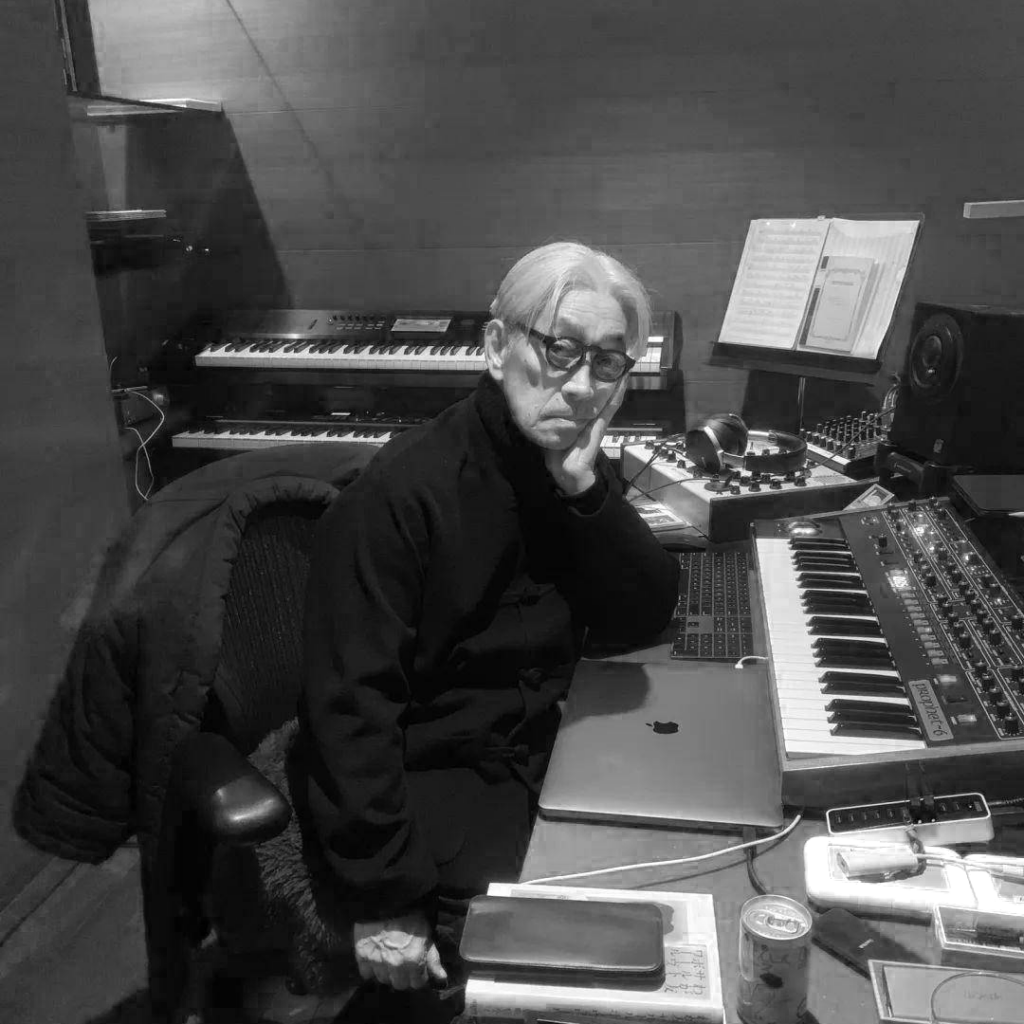
Ryuichi Sakamoto with his Prophet-6 (Source: unknown)
By the end of the 1980s, it felt like analog synthesizers were done. Over. At the time, the idea of anyone still playing a Sequential Circuits instrument decades later seemed almost ludicrous. But by the time Evolver appeared in 2002, that had changed. People valued vintage synthesizers less for their ability to emulate other instruments and more for their inherent sound, their unique “voice.” I can’t say that this change in attitude had a dramatic impact on the way the new instruments were designed. The goal is always to make a great musical instrument. But there is an awareness now that musicians are making choices less because an instrument is the next big thing and more because the experience of playing that instrument is satisfying and inspirational. In other words, more musical. As to what makes an instrument great, that’s complicated and maybe a subject for another, separate discussion. I will say that I think sales numbers are not necessarily an indication of greatness, or the only indication, anyway. And greatness can be very subjective.
As far as I’m aware, the Prophet-6 is still the second best-selling DSI/Sequential synth. (The Prophet Rev2 is first. If you consider the Rev2 an updated Prophet ’08—which it is—the combined sales numbers exceed any of the other synths by a large margin.) I was never overly optimistic about sales of any of the synths. I never thought, Oh, this is going to sell really well. The Prophet-6 was different. Yes, it “checked a lot of boxes,” but it instantly felt comfortable to me, and it sounded great. Any reservations I had about the limitations or the vintage-style interface quickly evaporated. It felt like any depth of function that was sacrificed was more than made up for by the immediacy and the joy of playing it. It felt like a musical instrument. And it was nice to be reminded of just how versatile a synth like that can be despite any perceived limitations. Maybe most importantly for me, the Prophet-6 made me rethink the musician/instrument interface in a way that greatly affected subsequent, more original designs. This is most evident in Take 5, which strikes a balance between a knob-per-function, live-panel interface and a deeper, menu-driven functionality that, while not hidden, stays out of the way for most interactions not directly related to playing, performance, and basic sound design. The synth provides immediate visual feedback for the foundational parameters while also allowing deep dives.
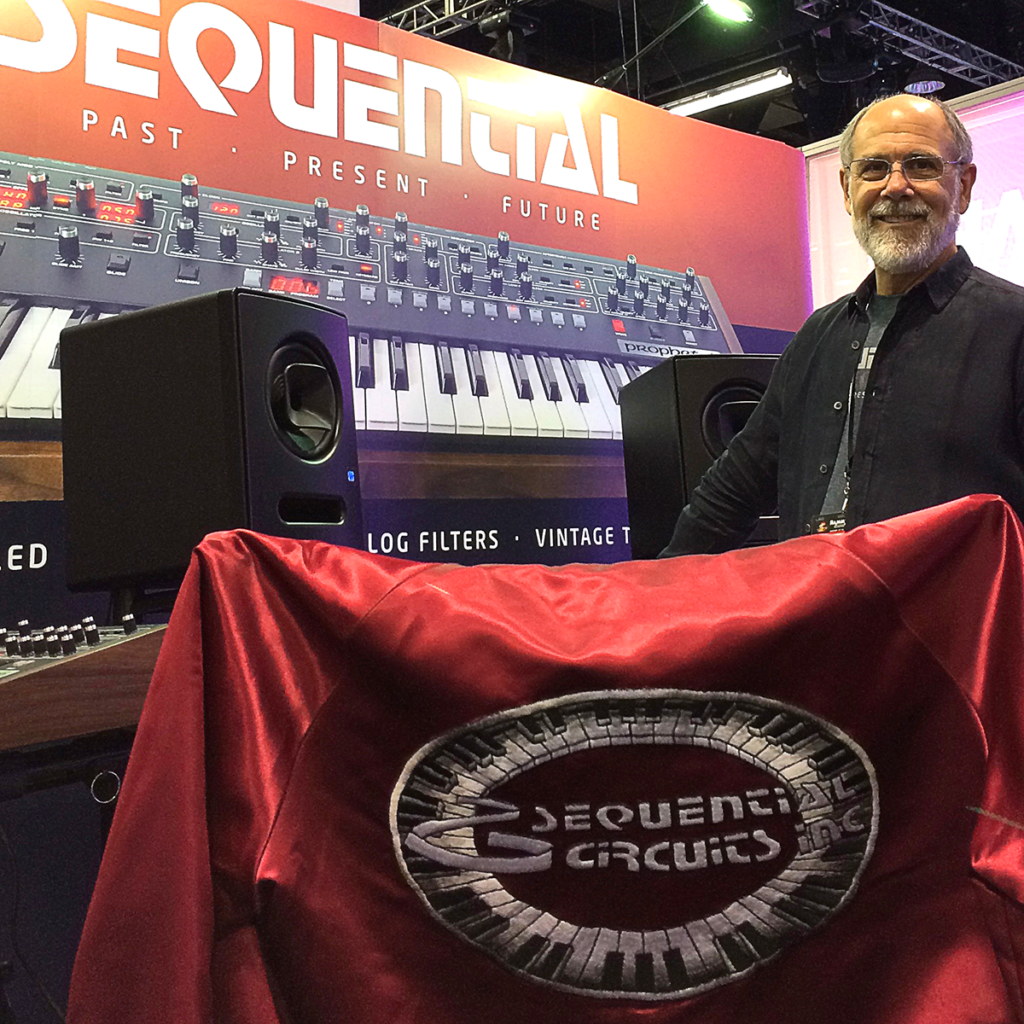
Photo: Joanne McGowan
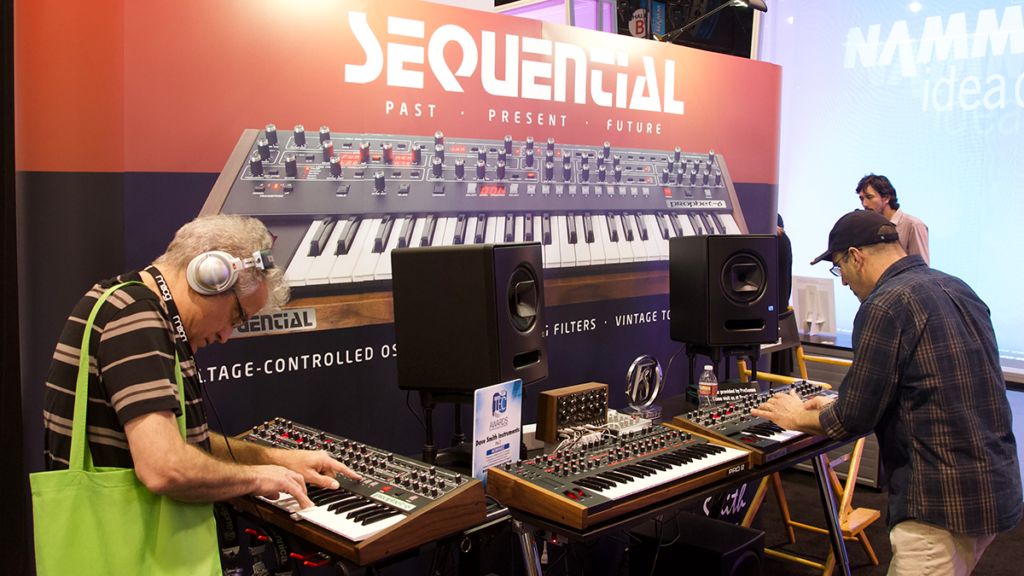
People were caught off guard by the introduction at NAMM in January 2015. The reaction was overwhelmingly positive and presales were strong, but the Prophet-6 was still far from production-ready. There’s an old joke that NAMM really stands for “not available, maybe March?” Or is it May? The point is, just because a product is announced and appears functional, it may not be ready for the world outside the Anaheim Convention Center. In addition to the alpha-to-beta mechanical and hardware changes already mentioned, there is always hardware fine-tuning to be done, like tweaking of signal levels and ranges. On the software side, the OS needs to be made feature complete and bugs need squashing. Ideally, that happens before sound design begins, but that is often not the case, so patches need to be tweaked, maybe more than once. The operation manual needs to be written, illustrated, laid out, edited, and—in those days, still—printed. There is testing, testing, and more testing. Packaging needs to be designed and samples approved. And as everything gets nailed down, parts have to be purchased from domestic and international vendors to show up at more or less the same time so that everything can be manufactured and assembled. In parallel, orders continue to be taken. The always looming question of “How many of these are we going to make?” must be answered and allocations considered. And then, finally, there’s a preproduction run and a “golden sample” and, barring any last-minute, hopefully minor tweaks, actual production begins. That all of this was accomplished start to finish in roughly a year seems miraculous to me now.
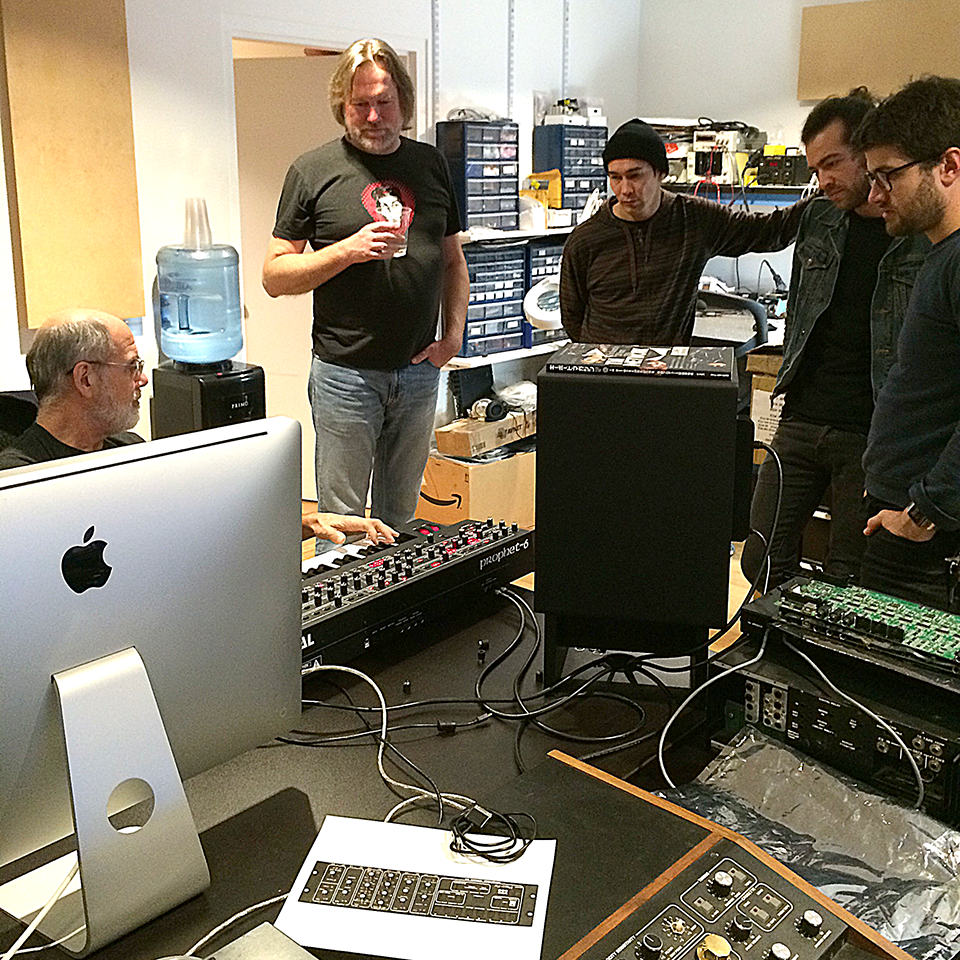
Wednesday, January 7, 2015 at the DSI office in San Francisco. From left to right, Dave, me, Mark Kono, Carson Day, Fabien Cesari (Photo: Joanne McGowan)
I didn’t document the development timeline for the Prophet-6 at the time, but some of the milestones can be determined from web searches and the few files that I still have.
February 9, 2013—Dave and Kakehashi-san Awarded Technical Grammy for MIDI
April 29, 2014—Preliminary list of front panel parameters
June 24, 2014—Initial front panel layout drawing
October 2014—Mechanical design and panel PCB layout begins?
December 19, 2014—First of 5 alpha units assembled
January 22, 2015—Re-acquisition of Sequential trademarks and Prophet-6 announced and alpha unit debuts at Winter NAMM.
Early 2015—Fifteen beta units assembled
May 2015—First production units ship
After the development really got under way in October of 2014, my memory of what happened and when is spotty. That’s not surprising, given that I was doing mechanical and graphic design while working with our vendors and contract manufacturer who would be handling the production of various parts, including metalwork, wood, nameplates, the Prophet-style switches, the 7-segment displays, display windows, and key bed. In retrospect, the fact that we went from a panel drawing to alpha units in roughly two months is mind boggling. During this time I was coordinating with Tony and Chris who were working just as hard cranking out hardware and software designs. Tony probably got a head start on the schematics before I could give him dimensions for the PC boards and Chris likely did some architectural software work, but a ridiculous amount of work was done during those two months. (I hope to talk to Tony and Chris about the Prophet-6 in the future.)
I do remember the first time I played a Prophet-6. It was on a table in Dave’s office at DSI in San Francisco. I walked up to it and played it and was immediately both relieved and excited. Relieved because it already sounded very good and excited because the potential was obvious.
That first instrument was one of five alpha units built. In researching this, I was surprised to see that the instrument that appears in Dave’s introductory video is an alpha. By extension, the instrument heard in Peter Dyer’s soundtrack to the video would also have to be an alpha, as were demo units at NAMM. Clearly, they were mechanically solid and sounding good even though they were not feature complete.
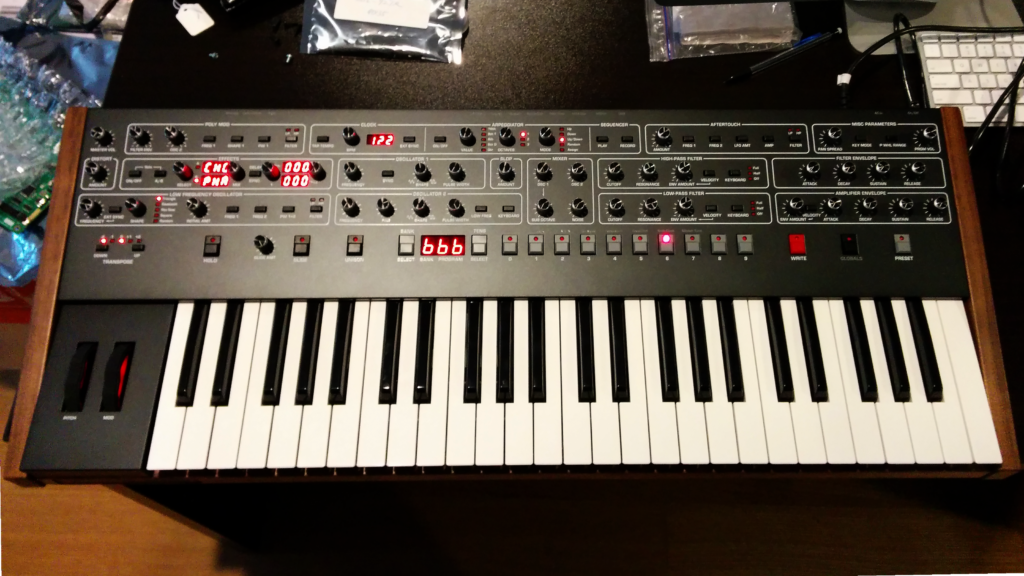
Photo of the first alpha unit taken at DSI on December 19, 2014. Can you spot the differences? The aluminum Prophet-6 name plate is missing because we hadn’t received them from the vendor yet. If you look closely at some of the original promo photos online, you can probably tell that it is Photoshopped in.
What changed between alpha and beta? There were likely lots of software changes and some hardware changes, but I’m only qualified to talk about the parts I was responsible for. As mentioned earlier, the original design only had 5 clock divide values. The beta version has twice as many. (The order of the clock divide values changed between beta and production, but that only necessitated minor changes to the OS and the panel’s screen-printing art.) The alpha version only had 1 bank of 10 global parameters. It quickly became apparent that was not enough, so the beta had 2 banks and the Globals switch went from having a single, red LED to two, red and yellow. As I also mentioned earlier, the Off LED was removed from the two filter keyboard tracking switches and the layout was tweaked to match the other small, 2-LED switches. I still have one of the beta units and it is as fully functional as, and compatible with, the production version. (I have a production unit, too.)
While on the subject of the name plate, here’s another bit of trivia. From its inception, the Prophet-6 was intended to be a Sequential product, but there was some reason—that I no longer remember—that we might not be able to use the name Sequential, so an alternate version of the name plate on the front of the synth was made that read “DAVE SMITH” in the same typeface as the Sequential logo. I am very happy that we were able to use Sequential.
Photo: Justin Labrecque
Why is it “Sequential” and not “Sequential Circuits?” Though Dave’s original company was Sequential Circuits Inc, customers and industry folks tended to refer to the company as “Sequential” or “SCI” at the time. And who could blame them, really. Sequential Circuits Inc is too damn long, especially in an age of domain names and email addresses and hash tags. Too much typing. Thankfully, SCI had dropped “Circuits Inc” from the products by the mid-’80s, opting for just “Sequential,” so we went with that. (If you want to get really picky—and I know how some of you synth folks can be—the original name of the company as it appears on early products and the first t-shirt is Sequential Circuits Co, not Inc.)
With the drawing updated and complete, it was time to start making the drawing a reality. I set about working on the mechanical design. One of the first things that needed to be done once we had a basic mechanical design was to translate the panel layout into a dimensioned drawing so that hardware engineer Tony Karavidas could lay out the panel PCBs. Tony would also lay out the main board and then I would get a dimensioned drawing from him so that I could add the PCB mounting hardware to the bottom panel metal and add back panel cutouts for things like phone jacks, MIDI jacks, and the USB port.
One major difference between the Prophet-6 and every Sequential Circuits and DSI instrument that had come before it, is that it has discrete VCOs and VCFs. (Some would quibble over whether they are truly discrete as there are some silicon packages involved, but I’m going with discrete. No sane person likes to match transistors.) Historically, every Sequential Circuits instrument used either Solid State Music or Curtis Electro-Music VCO and/or VCF chips, not to mention envelope and VCA chips. When Dave started DSI in 2001, the only analog synthesizer chip still in (limited) production was Doug Curtis’s CEM 3397 and it was used in every instrument leading up to the Prophet-6, with the exception of the Pro 2, which had DSP oscillators and discrete (there I go again) SSM 2040-inspired and SEM filters. As I write this in 2025, there are multiple VCO-on-a-chip and VCF-on-a-chip options. In 2014, there was one (technically DCO, not VCO) and it wasn’t suited to the instrument we had in mind.
Tony was responsible for the design of the individual voice cards, each sporting two VCOs, the triangle suboscillator, a SSM 2040-inspired, 4-pole, discrete OTA, low-pass filter, and a 2-pole, resonant, high-pass filter.
A note about the filter. There were a couple of 2040 filter clone schematics floating around online at the time, the most well-known being the late, great Jurgen Haible’s and a variation produced by Rene Schmidt. However, neither of those designs were used. We did what Jurgen likely did when designing his. We went back to the original 2040 design documents and the data sheet. I also hesitate to call the Prophet-6 filter a SSM 2040 clone, because we never actually made direct comparisons with a genuine 2040. We just knew it sounded good.
All of this happened relatively quickly, as software design couldn’t really get going until there was hardware to work with. Software engineer Chris Hector was responsible for much of the operating software of the synth, with Dave focusing on the low-level programming, like CV-related tasks and other things related to making the voice work. That was what he liked to do. He had employees to do the things he didn’t want to do. Dave loved “bringing up” a synth. That is, getting it to make noise—any noise–for the first time.
One of the great things about the Dave Smith Instruments development team was that everyone knew what they needed to do and how to do it and, given the distributed origins of the company (that is, everyone working on their own at home), everyone was capable of working independently. That said, there still needed to be someone steering development and making sure we all knew what everyone else was doing, keeping us focused on the job at hand and stepping in as an editor or referee as needed. Dave was a great project manager. If that sounds like faint praise, look at it this way: Not one of the instruments that came out of Sequential Circuits or DSI would have happened without Dave. He was the key to everything.
The one aspect of the Prophet-6 that got Dave excited was the prospect of building an analog polysynth without the limitations imposed by the microprocessors of the ’70s and ’80s. Dave had a knack for problem solving. One could argue that the Prophet-5 was inspired by his desire to solve problems. The same could be said for MIDI. With the Prophet-6, he wanted to eliminate the Tune button.
The tuning stability of voltage-controlled oscillators (VCOs) and filters (VCFs) is affected by temperature. There are various things that can be done in hardware to improve the stability, but nothing completely eliminates the issue. If it’s a monophonic analog synthesizer, you can turn it on well in advance of when you need to play it, and hope that its internal temperature and the ambient temperature reach a point where they’re stable enough that you can tune the synth and it will stay in tune while you perform. However, if it’s a polyphonic analog synthesizer, even small differences in oscillator and filter tuning between voices become apparent. Air conditioning ducts and direct, unfiltered sunlight are not your friends.
Enter the Tune button. The Prophet-5—and most of the programmable analog polysynths that followed it—had an autocalibration routine that could be run to get the oscillators and filters back in line. Hit the Tune button, hope the synth reawakens before the downbeat, and—voilà!—back in tune.
Dave’s solution for the Prophet-6 was to use the autocalibrate routine to build a table of oscillator and filter tuning offsets tied to the internal temperature of the synth at the time of calibration and then interpolate between them for a range of operating temperatures. The calibration still must be run manually, but once the tuning table is populated, calibration should only need to be run when the operating temperature is beyond the extremes of what’s in the table, eliminating the need for a dedicated Tune button. Brilliant!
(People sometimes ask me if Dave had any patents. I don’t think he really believed in patents. He definitely didn’t want to have to deal with [or pay] attorneys, unless it was absolutely necessary. So, to recap. Marketing.Patents. Lawyers. Furthermore, when it came to synth design, he didn’t like slide potentiometers, white synthesizers, synthesizer models designated with combinations of letters and numbers like “XL-5,” or light-hued wood like maple or ash.)
The Effects
Bob Coover’s DSP contributions first appeared in the Prophet 12 in 2013, but the Prophet-6 was the first DSI instrument to have a dedicated multi-effects processor. We made a list of what we thought were “must have” effects. I no longer have that list, so I’m relying on my memory here, which may be faulty. I believe most of the effects on the list appeared in the initial offering: BBD delay emulation (which had first appeared in the Pro 2), “clean” digital delay, chorus, phase shifter, and hall, room, plate, and spring reverb emulations. Flanger and tape delay were also on the list. I don’t recall when the flanger made it in. Maybe when the effects were updated for the OB-6? (The OB-6’s ring modulator, a tribute to Tom Oberheim’s vintage effect, was also rolled back into the Prophet-6.) The tape delay never did make it in and didn’t appear in an instrument until Take 5. Why did it take so long? No idea. Lack of DSP horsepower, maybe? I was pushing for it. The model already existed. In fact, “Drive” in the Character section of the Prophet 12 is based on the Echoplex model’s tape saturation.
The “Easter Egg”
If you’ve ever had a guitar amp or an old mixer with a spring reverb tank, you probably know that abrupt physical shocks can cause the reverb springs to make a thunderous, clattering sound. During one of the weekly meetings, someone suggested as a joke that it would be funny if the digital spring reverb emulation offered the ability to make that happen. I don’t remember who made the joke. It could even have been me. Then someone—Dave, I think—suggested adding an accelerometer and some samples of a reverb tank being bashed for the sole purpose of making the joke a reality.
To hear it, the spring reverb effect must be active and the mix level turned up. Then just slap one of the wood end panels hard with your open hand.
Dave demonstrates the “Easter egg”
As far as I am aware, the effect was rarely triggered unknowingly. I think Technical Support did receive a report from a customer who encountered it while playing in a very loud, bass-heavy environment.
Note: The accelerometer used in the Prophet-6 is now obsolete. If stock of the part becomes depleted before production ceases, it will no longer be present on the PC board. If you’re whacking your synth and nothing is happening, that might be why.
When I started at Dave Smith Instruments in 2007, there was no DSI office, and that continued for several years, with everyone working at home. We would have infrequent meetings at Dave’s home in St Helena in the Napa Valley, but most business was conducted via email and <gasp> telephone. Somewhere around 2010 or 2011, a small office in an industrial area of San Francisco was rented, mainly to give the company’s younger, apartment-dwelling folk somewhere to go. By 2014, DSI had moved into an office in the North Beach neighborhood of San Francisco, and Joanne and I were in a small office on Main St in Half Moon Bay, California, where we lived at the time. (Joanne McGowan is my spouse/partner and was DSI/Sequential’s General Manager and employee number 2, starting about 10 months after me.)
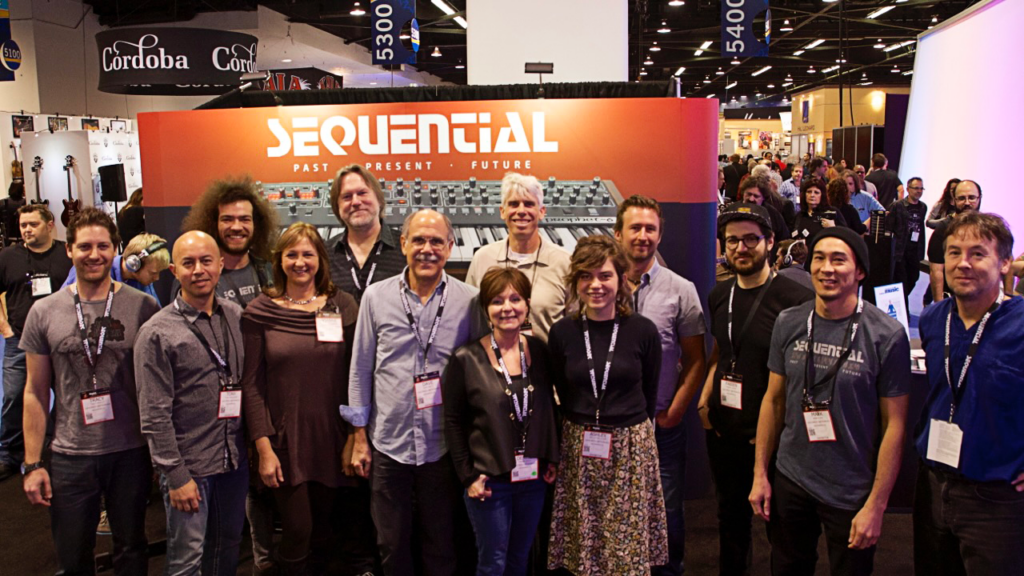
The early 2015 edition of DSI: (from left to right) Tracy Wadley, Tony Karavidas, Carson Day, Joanne McGowan, me, Dave, Denise Smith, Bob Coover, Ashley Bellouin, Chris Hector, Fabien Cesari, Mark Kono, and Mark Wilcox
In 2014, Dave had 10 full-time employees, and we would meet every Wednesday at the San Francisco office so that each of us would know what the others were doing and what the status of current projects was. I would introduce my first attempt at a Prophet-6 front panel layout at one of these meetings. There was one issue: I had drawn the Effects module as we had discussed it, with a single effect available at a time. The more time I spent on the layout and the more I thought about it, the more convinced I became that it had to have two simultaneous effects. Had to. Modulation effect and reverb. Modulation effect and delay. Delay and reverb. And so forth. I don’t think I had discussed this with anyone else. I knew Dave had concerns about the cost of the DSP chip and/or adding RAM, and I didn’t know if we had the horsepower to handle two simultaneous effects.
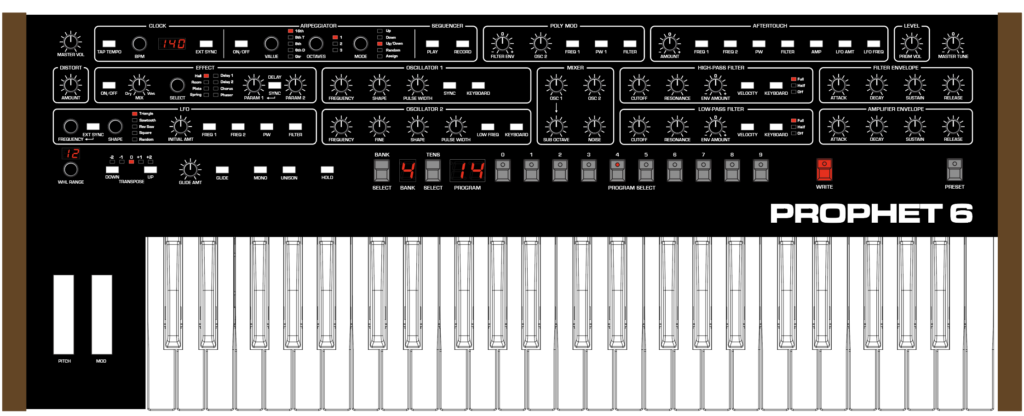
The first drawing with the single effect processor and other differences.
I showed the drawing in the staff meeting and voiced my concern about single versus dual effects. I think there was almost universal agreement among the employees that two effects were necessary. (There were one or two holdouts who were not convinced that the Prophet-6 should have digital effects at all.) I’m not sure Dave even expressed an opinion, so I don’t recall whether he was for or against. In general, if there was near unanimous agreement about something, Dave would go along, even if he was not a fan of the idea. Don’t get me wrong. One of Dave’s superpowers was his ability to say no, even when it was unpopular. It was part of what enabled him to get things done quickly. In this case, there was little or no debate.
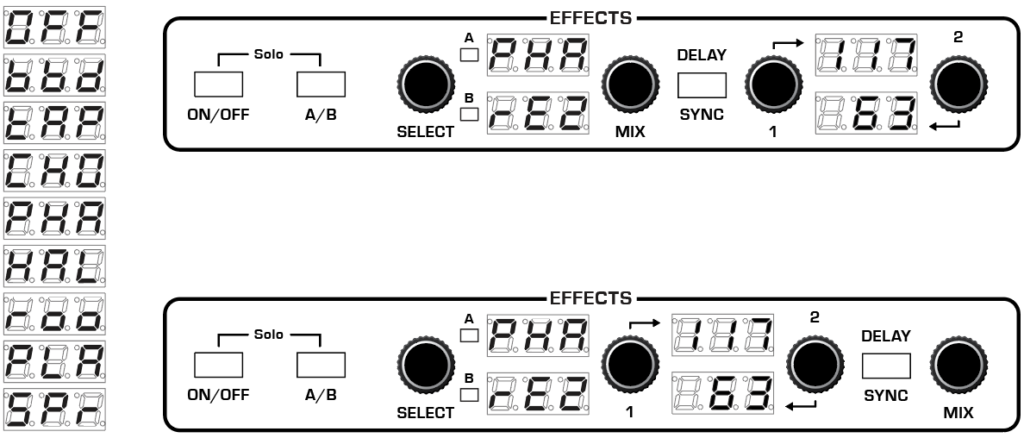
In situations like this, I would typically have an alternative solution available to show how it could be done. I made a drawing of just the Effects section with dual effects that was substantially the same as what ended up in production, but don’t remember if I did it before or after the meeting. A bit of trivia: The Effects section breaks the rule we had established regarding the user interface being knob- and switch-per-function. The single effect version had a Mix knob that was a potentiometer or “pot.” In manual (Preset off) mode, the knob would have accurately reflected the current value of the effect mix. In the dual effects layout, Mix is a rotary encoder and you don’t know what the level of the active effect is until you turn the knob, displaying it temporarily in place of the effect type. I could not come up with a better solution given the limited amount of space available. I think it was worth compromising to get that second effect.
Two alternate designs for the Effects section to add a second effect. The top one was the version used. The “tAP” display would have been for the Tape Delay effect.
The only other issue I recall was that there was some discussion about the utility of the step sequencer, and I was/am in total agreement that it is limited. There wasn’t space available to add more functionality and nobody could come up with a better use for the space that was there, so it stayed. That said, I can watch Jason Lindner do one of his improvised sequencer meltdowns over and over and not tire of it, and I was very pleased to see Gil Assayas (AKA Glasys) using the step sequencer to replicate the sound of early Utopia when he toured with them.
Looking at that initial drawing 10 years later, there are a few things that changed in later revisions of the drawing. Wheel Range was moved to a new “catch-all module” for miscellaneous parameters. Master Tune was moved to Globals. The Bank and Program displays were combined into a single 3-digit display.
There are two items that made it all the way to alpha hardware, the Off LEDs for filter keyboard tracking and half the final number of options for clock divide values. Once we had alpha hardware, it was obvious the Off LEDs were unnecessary. If neither Half nor Full are lit, keyboard tracking is off. The “missing” clock divide values are a bit of a mystery to me. I have no recollection of it being this way and looking at it now, it just seems, to use a Dave word, dumb. And it didn’t get changed until beta hardware. Maybe it was so dumb I purged it from my memory.
One important UI element that was not yet present in the initial design is a method for configuring the global parameters. Without a graphic display, the three 7-segment displays were the only way to display those settings and values. Thankfully, most of those parameters are “set and forget,” so the UI would not get frequent use. The decision was made to add a Globals mode switch that would enable the program switches to have the alternate function of selecting the global parameters. I added light gray text to the panel artwork to differentiate the global parameters from the normal operating parameters and to make the globals not visually “pop” so much.
I never really had a job title until I needed one for the company’s acquisition by Focusrite: Senior Product Designer. As titles go, it’s okay, I suppose, and generally describes my role. (My first Dave Smith Instruments business card gives my title as The Other Guy, as in, “Dave and the other guy.”) I did occasionally think that if I ever wanted to work somewhere else, having an important-sounding job title might be helpful, but as it turns out, that wasn’t necessary. I just kept doing what I did until I didn’t anymore.
DSI employee number 1, AKA The Other Guy
DSI had a pretty unique way of developing products. We never had a shortage of product ideas, so the first step was to decide which of them we wanted to tackle next. That decision was not driven by Marketing or the vagaries of the synthesizer market—Dave generally thought Marketing was a waste of time and money—but rather by what seemed interesting to us. After all, we were all synth dorks, so if we thought something was interesting, the odds were very good that other people would, too. And if we did a good job, we would sell enough of that instrument to allow us to make another one. That was all we really cared about. Gradual growth and products that continued to sell over a period of years were more important than maximizing sell-through and then scrambling to come up with the next thing.
The Prophet-6 was a bit unusual in that we had a solid idea of what it was and what it looked like and the awareness that, if we didn’t screw it up, it was going to sell well, but the process was still the same. Typically, we didn’t write specs. We drew pictures, starting with the front panel. (The one exception to this was Tempest, for which Roger Linn created a lot of preliminary documentation.) Most instruments started with whiteboard drawings before moving into Adobe Illustrator, but I don’t recall much time being spent at the whiteboard for the Prophet-6. We knew the general size and shape. The length was determined by the 4-octave keyboard plus a wheelbox and we wanted to limit the width (front to back) to keep the instrument to a size that was easily portable and didn’t take up a lot of room. We wanted to avoid adding a spacer at the right end of the keyboard to increase the length and gain additional panel real estate. (At the time, we were getting a lot of feedback from customers about space limitations in their workspaces.)
I started by doing some preliminary mechanical design to better determine the actual dimensions. When I first started working at DSI, all the drawings—panel graphics, screen-printing art, and the mechanical design—were done in Adobe Illustrator. I don’t know why. Maybe Dave already had a copy when he started working on Evolver. Maybe he knew someone and got it cheap. He needed Illustrator or something like it for the graphics, so maybe he just thought, why learn Illustrator and some CAD software when I can do everything in Illustrator? (Evolver was Dave’s first solo synth design in a long time and things had changed greatly in the intervening years, largely due to the advent of personal computers.) In any case, that was fine with me, because I was already familiar with Illustrator from my time as a technical writer. The tools are not great for mechanical drawing, but you can do parametric entry and snap to grids, so it’s workable.
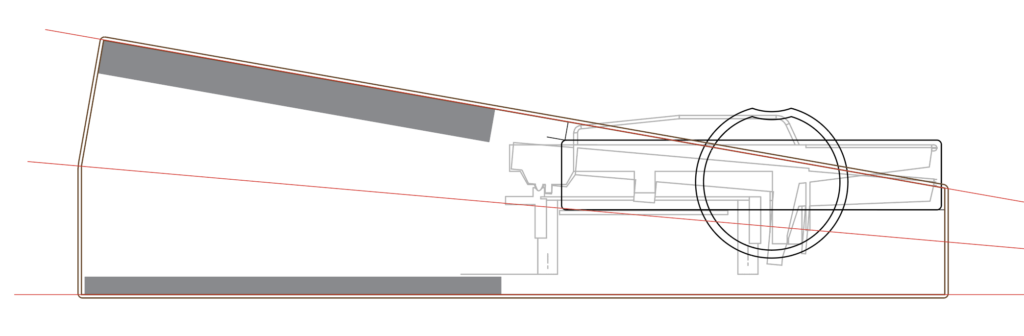
The first Illustrator sketch to determine approximate dimensions.
When I first started at DSI, the 2D Illustrator drawings would be given to the metal and wood vendors who would then build 3D drawings in SolidWorks. I did gradually transition to working in 3D—the Prophet 12 module was the first complete product I modelled—but I started sketching the Prophet-6 in Illustrator before moving over to the CAD software. I had 2D drawings of the 4-octave, Fatar keyboard and the pitch and mod wheel assembly, so I drew a profile view from the right side from which I could derive the useable width, meaning the area of the panel in which the panel PCBs would fit without running into obstructions like the rear of the keys. So, I had a realistic estimate of the length and width to use as a starting point for the panel layout. (A note on terminology: Though it’s common to describe the end-to-end dimension of a keyboard as its width, length is, by definition, the longest dimension of an object, so width in this case refers to the front-to-back dimension and length is end to end.)
I didn’t have to give much thought to graphic design because the “rules” had already been established by Dave when he designed the Prophet-5. White-on-black screen printing with “modules” bounded by borders with rounded corners, and Eurostile for the typeface. (The Prophet-5 typeface was Microgramma. Eurostile is a very commonly used digital typeface and essentially an updated version of Microgramma.) Dave would have laid out the Prophet-5 panel art by hand using dry transfer lettering, lines, and corners—probably on some sort of graph paper—which was then photographically reduced to make the screens for silkscreen printing. Creating the graphics in Illustrator is faster, more editable, and more accurate. Computers for the win! The screen printing for production is still done by hand, just as it was in “the old days.” Industrial screen printing is becoming something of a lost art. I put a lot of effort into qualifying vendors for production, especially for instruments like the Pro 3 SE. The Prophet-6 was relatively simple and just two ink colors.
The panel was smaller than the Prophet-5’s with more knobs and switches, so I used a 20-lines-per-inch (.05″) grid to give me flexibility while also adhering to a grid. I think I remember from laying out the Prophet-5 Rev 4 panel that it was on a .125″ grid. Bigger panel; fewer controls. I can’t recall if I did this on the Prophet-6, but I sometimes went “off grid” when it felt right. I feel that the layout of a musical instrument can be too rigid, especially one with a lot of UI elements. It’s beneficial—maybe even more musical, in a way—to be able to identify different sections of the UI based solely upon the pattern or arrangement of the controls. (Am I getting too “inside baseball?”)
The first layout went relatively quickly. As always happens, there were some surprises. I had trouble getting things to fit with individual waveshape switches à la the Prophet-5, so I changed it to a knob that swept continuously from triangle to sawtooth to pulse waves. That meant, unlike the Prophet-5, each of the 3 waveshapes was available on both oscillators and an additional destination switch would enable waveshape to be modulated via Poly Mod. It also meant, as John Bowen would find out when trying to recreate the 40 original Prophet-5 programs on the Prophet-6, one or two of the original factory presets couldn’t be replicated exactly because that combination of waveshapes was not available using the knob. I was more than willing to make that trade.
As often happened when laying out a panel, there was an odd space that wasn’t easy to get rid of by simply shuffling things around. (This is preferable to running out of space before everything is placed on the panel, however.) To fill the space, I added a very rudimentary step sequencer, just Record and Play switches.
You might ask, how could there be no room for the waveshape switches and extra, unfilled space? The user interfaces of integrated or “slab” synths typically group controls into modules of related parameters, so much of the layout process involves not just moving individual controls, but groups of controls. It’s a bit like a (very slow) game of Tetris where you’re trying to make things fit together as seamlessly as possible without any gaps. Layout generally requires a lot of thought and multiple iterations before arriving at something that looks and feels right, and—in some cases—elements need to be added or removed or combined into a single control to make it work. (One of my least favorite tasks as a designer was laboring intensely for months over the layout of a keyboard instrument and then having to change and adapt that layout relatively quickly for a desktop module. I rarely felt completely satisfied with the results. The two exceptions are the Prophet Rev2 and OB-X8 modules, the latter with the capable assistance of Carson Day.)
Having established a rough concept, it was time to start filling in the details. Dave surprised me, saying, “You know what it should be. You do it.” It wasn’t that I didn’t feel up to the task. I just didn’t expect it. Honestly, I did feel like I knew what it should be. At that point I’d had 35 years to think about it. I don’t think it was until I left Sequential in 2024 that I really had a chance to consider the implications. The guy who designed one of the most significant synthesizers in history had given me the opportunity to design a follow-up. In 2014, I was excited by the prospect, but I had a lot to do, and my focus was on doing it well, just as it would be with any other instrument design.
The reasoning behind Dave’s decision was simple: He had no interest in making another Prophet-5 or even a Prophet-5-like synth, so it was easy for him to hand it off. Almost from the time the Prophet-5 ceased production, people had been asking him to make another one and he declined. He always wanted to do something new, not revisit the past and repeat himself.
(Obviously, Dave changed his mind at some point or there would be no Prophet-5 Rev 4. As to why, Dave had his public pat answers, as he did for many frequently asked questions. I don’t recall ever asking him directly why he had a change of heart, though I have some thoughts about it. Since the man is not here to confirm or deny, I will keep my thoughts to myself.)
Forward, Into the Past!
Having worked at Sequential Circuits from 1979 to when the company folded, there was—in my mind—only one synth that was a direct descendent of, and successor to, the Prophet-5: the Prophet T8. Honestly, I have mixed feelings about the T8. (It doesn’t help that, as a production technician, I calibrated many, many of the keyboards, which was a time-consuming and tedious job.) The biggest issue I had with it was that its raw sound did not, in my opinion, compare favorably with the Prophet-5. That said, the T8 had some evolutionary improvements that were among the first features I added to the Prophet-6.
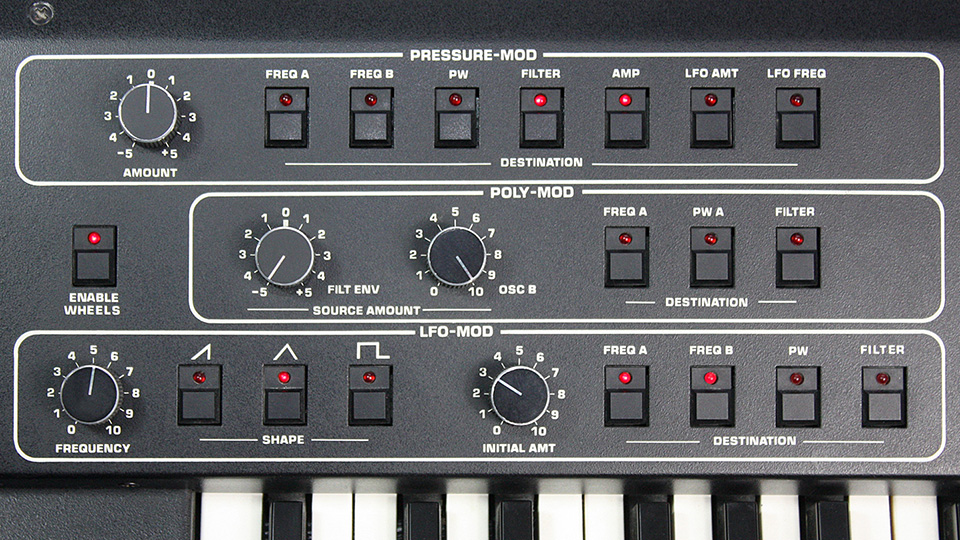
Programmable LFO Amount The Prophet-5 was the first fully programmable polyphonic synthesizer. Mostly. Let’s say you’re at a gig and there’s a patch used in a song’s verse that requires the LFO to be on continuously, so you push up the mod wheel and start playing. Then you change to the patch for the chorus, hit the first notes and…. Oops. You got lost in the moment and forgot to return the mod wheel to minimum, so the synth is playing with unwanted vibrato or whatever the LFO is routed to for that patch. The T8 addressed this by adding an Initial Amount parameter to the LFO section, making the LFO amount programmable and not dependent upon the wheel setting.
Bipolar Modulation Another thing the T8 added was bipolar modulation amounts. That is, some of the mod amount knobs could be set to positive or negative values. This was one of my favorite T8 features and it expanded the synth’s sound design capabilities in a very simple and effective way without adding knobs or switches. And that was important, considering that real estate on the Prophet-6’s front panel would be somewhat limited by the 4-octave keyboard.
A portion of the Prophet-T8 front panel showing both bipolar mod amounts and LFO Initial Amount (Source: greatsynthesizers.com)
Program Volume Program Volume also debuted on the T8, but that was already a standard feature on DSI synths.
Unison to Mono and All Points In-between
I have always felt that the Prophet-5 was somewhat lacking in its capabilities as a mono synth. Ten VCOs stacked in unison can be great if girth is your goal, but there are applications when just 1 or 2 oscillators is preferable and there is no easy way to achieve that in unison mode. The Prophet-6 would use any number of its 6 voices for unison patches, along with detuning for 2 or more voices. Chord Hold, which can be traced back to the T8 and Prophet-600, would be added as an alternate, programmable, Unison mode.
Hold On…
While on the subject of Hold, I don’t think the Hold button was on any SCI synths and first appeared on a DSI instrument with the Prophet 12. I was inspired by seeing Jason Lindner with the Proverb Trio. I noticed that he used the Envelope Gate switch on a Moog Voyager to gate the voice on and make it drone, making two-handed knob twiddling (and a whole lot of fun) possible. Prior to the Prophet 12, drones on DSI instruments could be achieved by turning up the VCA level, but on the polyphonic instruments, that meant all the voices would sound. Hold causes whatever voices are gated on manually to be held until Hold is turned off.
We’re Not in 1983 Anymore
MIDI may have had the most profound effect on the design. The Prophet-5 never really had fully integrated MIDI. Even the later Rev 3s that shipped with MIDI had the same MIDI kit installed as instruments retrofitted with MIDI. The only difference is that the holes for the DIN jacks came from the metal vendor pre-punched.
The Prophet-5’s MIDI implementation was rudimentary. It goes without saying that the Prophet-6 would have a 21st century MIDI implementation with full automation capabilities, but what about synchronization? Clock sync is vital for a lot of modern music production. What, exactly, is getting synchronized? We had an LFO and (presumably) time-based effects. We had already been considering an arpeggiator, but the ability to sync it to other onboard features made it seem like a necessity. (My memory is a bit foggy on the subject, but I don’t think the step sequencer came into play until I started drawing the front panel.)
Me, Me, Me
There were a few things that I really wanted in the Prophet-6 that were not Sequential Circuits-like. I’m a big fan of distortion as an effect and I lobbied hard for it to be included in Tempest, the first DSI synth to include it. Dave and Roger Linn had come up with a simple high-pass filter into asymmetrical diode clipper circuit that found its way into subsequent instruments, so I added it to the Prophet-6. As anyone who is familiar with an Evolver probably knows or, at least, suspects, Dave liked grungy sounds and didn’t need any convincing to add a distortion. (On the other hand, when I was designing the OB-6, Tom Oberheim’s only instructions to me were that he wanted the OB-Xa’s blue lines and no distortion. Of course, as soon as the sound designers got their preproduction OB-6s, one of the first questions was, “Where’s the distortion?” Since the Prophet-6 and OB-6 share a common main board and the distortion is on that board, the distortion could be added back in as a hidden feature, but I still regret that it doesn’t have a dedicated knob.)
Tempest was also the first of our instruments to have an analog high-pass filter per voice. For the Prophet 12, resonance was added to the high-pass and I felt like it opened up a lot of possibilities. One thing to consider when designing an analog poly synth is that any feature added to the voice architecture gets multiplied by the number of voices, adding to the cost. The resonant high-pass filter is relatively inexpensive, so I felt its inclusion was warranted given the added sonic flexibility.
I like suboscillators. One thing I don’t like about most suboscillators is that I feel the waveshape—typically a square wave an octave below the oscillator frequency—adds harmonics that I don’t necessarily want. I much prefer the suboscillator to reinforce the fundamental to add “beef” without affecting the overall timbre. Ideally, that requires a sine wave suboscillator. The issue is that a square wave an octave down is easy to generate and “parts light.” That is, inexpensive. That is not necessarily the case with a pure sine wave. So, I asked our hardware engineer, Tony Karavidas, if he thought he could come up with an inexpensive solution to generate a triangle-shaped suboscillator, and he said he thought he could. He may have regretted that later, as I think considerable tweaking was necessary to maintain the triangle symmetry. I think it sounds great, though, so thank you Tony. (The OB-6 has square wave suboscillators, but I think they sound good paired with the buzzier, more aggressive-sounding SEM filters.)
Another small thing that I wanted to add was the dotted 8th note value to clock divide, which had not been available in previous DSI products. Because I like David Gilmour. (If this doesn’t make any sense, listening to Pink Floyd’s “Run Like Hell” might shed some light?)
The Survey
Dave always liked to say that the instrument designs were entirely generated in house with no external input, though that was not entirely true. The initial idea for Tetra came from Morgan Page at a NAMM show. Morgan had a Prophet ’08 and a Mopho module. He was traveling a lot and said he liked the Mopho form factor—I think he said it fit in his shaving kit—but wished it was polyphonic. Dave and I looked at each other and literally said, “Hmmm.”
I also had a small circle of people I consulted with over the years, not necessarily well-known artists, but professionals who work with synths daily. I wouldn’t ask them vague questions like, What do you think we should make? More often than not, it was more along the lines of, I’m thinking of doing <insert feature/design idea here>. Is that dumb? Occasionally they would say, yes, that’s dumb. (Thank you, Peter Dyer.) And sometimes I wouldn’t listen to them even if they did, if I was convinced it was something worth pursuing.
For the Prophet-6, I did something I never did with any other instrument: I sent out a questionnaire asking a few people some specific questions about a hypothetical, Prophet-5-like synthesizer. I wish I still had the questions, as I don’t really remember what I asked. I know I asked about 4 octaves versus 5, even though that decision had already been made. And I wanted to get a sense of how people might feel about digital effects on an analog synth.
I also don’t remember exactly who I sent the questionnaire to. I know I asked Dave Stewart (Hatfield and the North, National Health, Bruford, Dave Stewart and Barbara Gaskin). Dave has long been one of my favorite Prophet-5 players. (If I recall correctly, Dave wanted 5 octaves and no digital effects. Sorry, Dave. I do have a vague recollection that he asked about a desktop module to replace his Creamware Pro 12 ASB? Maybe that was later, though, when we were working on the Prophet-5 Rev 4.) I believe I may have asked Mike Lindup (Level 42) who was the first artist I ever saw (Keystone Palo Alto, 1985?) who was not content just to push preset buttons and actually turned knobs and interacted with the Prophet-5 while performing. I would have asked Richard Barbieri (Japan, Rain Tree Crow, Porcupine Tree), but I don’t think I was in contact with him in 2014. Maybe Atticus Ross? Drew Neumann? John Bowen? Probably Jason Lindner. Almost certainly my old friend and former bandmate Robert Rich. Definitely Peter Dyer and Matia Simovich.
In any event, the questionnaire was not particularly helpful and I never used that blanket approach again. I would, however, continue to ask specific questions of specific people from time to time just as a reality check.
Celebrating 10 Years of a Modern Workhorse: The Sequential Prophet-6
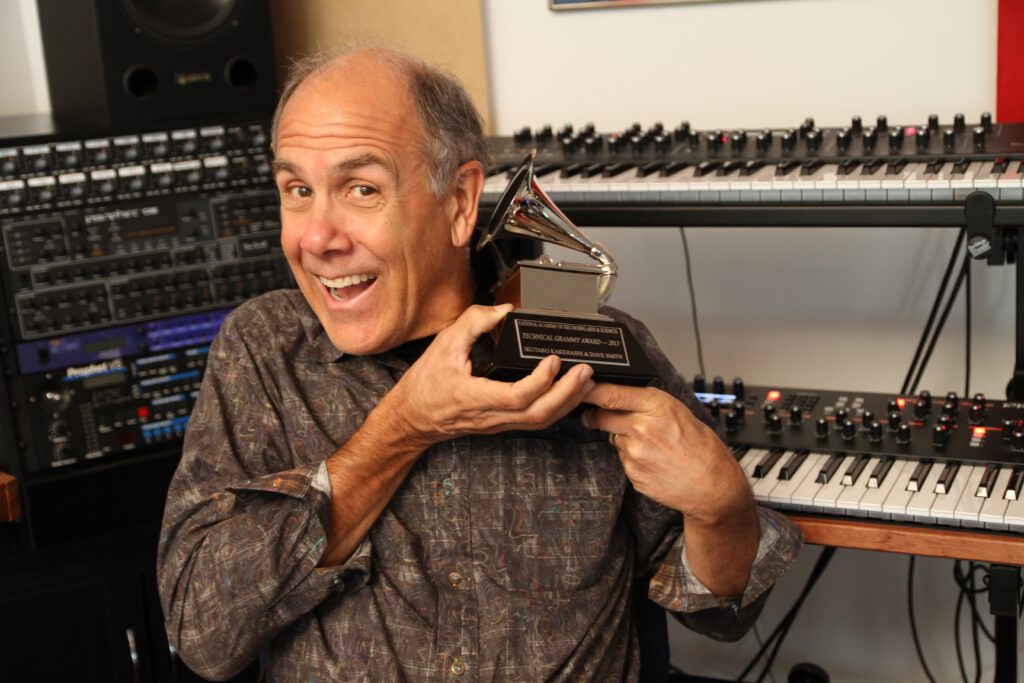
In 2013, Dave Smith and Roland founder Ikutaro Kakehashi were awarded a Technical GRAMMY for the development of MIDI. This set off a chain of events that neither Dave nor any of us working with him would have anticipated. Unbeknownst to Dave, Mr. Kakehashi contacted Yamaha Corporation President Takuya Nakata and asked if he would return the Sequential trademarks to Dave. The trademarks had transferred to Yamaha when they acquired the assets of Sequential Circuits in 1987, but they had never used them. Yamaha very generously agreed to the transfer, asking only that Dave pay the legal fees, which—as legal fees go—didn’t amount to much. For context, we subsequently paid about 5 times that amount for the sequential.com domain name, which I negotiated for and bought from a computer/software consultant who had used the name for his business. And that was considered a reasonable price for a single, dictionary-word domain name at the time.
Dave with his GRAMMY (Photo: Joanne McGowan)
We then had to decide how we were going to use the trademarks. I don’t think there was any immediate thought to change the company name, at least on my part. Initially, the idea was that maybe Dave Smith Instruments would continue to develop more “modern” instruments while there would be a separate line of more classically styled and inspired instruments sold under the Sequential name. In retrospect, not a great idea, but we had put a lot of time and effort into building the Dave Smith Instruments brand and it was finally starting to pay off. We were reluctant to change a brand name that was gaining momentum in the market. Add to that the fact that both Dave and I had experienced Sequential Circuits, and Dave Smith Instruments felt very, very different in so many ways.
Dave Smith is still not a household name—except in the households where one of the thousands of other Dave Smiths live—but when Dave started Dave Smith Instruments in 2002, even a lot of synth geeks weren’t aware of the connection between Dave and Sequential Circuits. Dave had always maintained a fairly low profile. There was a good chance a musician would know “MIDI,” might know “Prophet” and, fewer still, “Sequential Circuits,” but Dave generally flew under the radar. And he liked it that way. When Bob Moog and Tom Oberheim started new companies, they could no longer use their own names, but people knew their names. (In the late ’60s, “Moog” was literally synonymous with “synthesizer” for some people, even if the synth was not a Moog.) When Dave started a new company, he could no longer use his original brand name and people were mostly unfamiliar with him. That started to change gradually with the release of the Prophet ’08 in 2007 and the sharing of information via the Internet.
Dave and I started talking about what the return of the trademarks would mean to Dave Smith Instruments almost immediately after he learned of Mr. Kakehashi’s efforts. Two things seemed obvious: We needed to make a Sequential-branded instrument and that instrument should pay tribute to Sequential Circuits instruments of the past, the Prophet-5 being the obvious choice. Then our thoughts turned to, what would a 21st century Prophet-5 even be?
If a Prophet-5 has a graphic display, is it still a Prophet-5? A big part of the experience of playing synths from that era is that you must depend much more heavily upon your ears. While it would certainly be useful to have program names displayed, it might be difficult to resist the temptation to use menus to solve whatever operational issues might crop up during development. If it had a graphical display, but only displayed program names and numbers and a global settings menu, would there be complaints that we underutilized the display? We opted for a third 7-segment display to accommodate more programs and more MIDI-friendly program numbering. (The Prophet-5 had two 7-segment displays and discontiguous program numbering.) That would necessitate coming up with a way to display and edit global settings using the 7-segment displays.
No graphic display meant the synth would be knob-and-switch-per-function. Though there are obvious benefits to the player—like no menu diving, no modal operation (so knob and switch behavior never changes), and facilitating a preset-off or “live-panel” mode—we were a little concerned that some might find this too limiting. It was certainly a philosophical departure from the other DSI designs up to that point that had a lot of knobs and switches and shallow menus to access even more parameters.
We made the very intentional decision to put a 4-octave keyboard on it, fully aware that it might be controversial for some. I may go into greater depth on this subject at some point, though I don’t know that it’s warranted all these years later, especially seeing as the instrument was very successful and has many more champions than detractors. Was there any discussion of making it 5 octaves? Of course, and there were proponents within the company, but Dave and I were in sync on this matter from the start.
The instrument would be conceived with gigging musicians in mind, so it needed to be durable, (relatively) compact and light weight, and—though it was potentially controversial in an analog synth at the time—it should have onboard digital effects, potentially one less thing to carry.
Finally, we decided that this would be the Prophet-6 because a) that’s what comes after Prophet-5 and b) Dave had always felt that 5-voice polyphony was a little too limiting. (When the original Prophet first shipped in 1978 it was available in 5- and 10-voice versions, but the 10-voice suffered from technical issues and was quickly discontinued. Had that not been the case, the Prophet-5 may have been the historical footnote.)